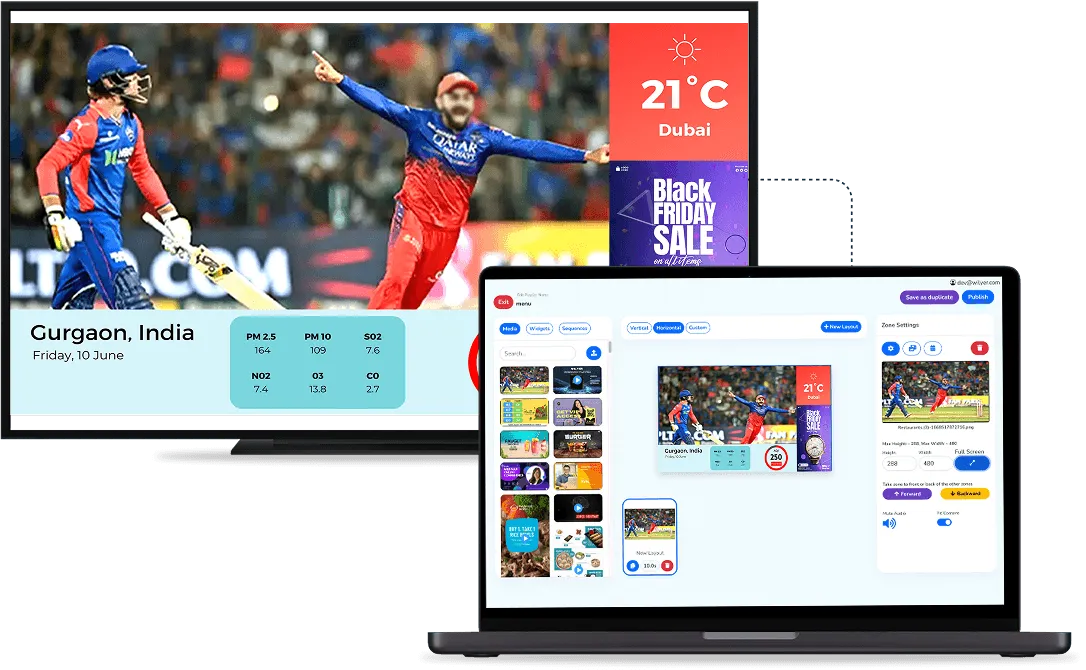
Digital Signage Software Solutions FAQs
A complete resource for software features, industries, and solutions in digital signage.
Search by question, category, device, pricing, or deployment topic.
How are updates and security patches handled in signage apps?
Understand how digital signage apps handle remote updates, security patches, and performance improvements across devices.
Read answer
Do signage apps support kiosk mode and full-screen playback?
Explore how signage apps support full screen playback and kiosk mode for secure and uninterrupted display control.
Read answer
Can one digital signage platform manage screens across different operating systems?
Learn how one digital signage platform can manage Android, Windows, Tizen, webOS, and Fire TV screens from a single dashboard.
Read answer

What hardware specifications are recommended for smooth signage playback?
Discover recommended hardware specs like 2 GB RAM and 16 GB storage for smooth digital signage playback and stability.
Read answer
How are signage apps deployed and managed remotely?
Learn how signage apps are deployed via USB or download and managed remotely through cloud dashboards and remote updates.
Read answer
Can digital signage run without an external media player?
Find out when digital signage can run without an external media player and when a dedicated player is required.
Read answer
Are Samsung Tizen and LG webOS supported by modern signage systems?
Find out when digital signage can run without an external media player and when a dedicated player is required.
Read answer
What is System-on-Chip (SoC) digital signage and how does it work?
Learn what System on Chip digital signage is and how built in operating systems eliminate the need for external media players.
Read answer
How does Fire TV or FireStick work with digital signage platforms?
Understand how Fire TV and Fire Stick work with digital signage platforms for small to mid size screen deployments.
Read answer
Is Android-based digital signage suitable for commercial displays?
Find out if Android based digital signage is suitable for commercial displays and large scale deployments across industries.
Read answer
Can digital signage systems run directly on Smart TVs?
Learn whether digital signage systems can run directly on Smart TVs including Android, Samsung Tizen, and LG webOS commercial displays.
Read answer
Which devices support cloud-based digital signage platforms?
Discover which devices support cloud based digital signage including Android, Windows, Samsung Tizen, LG webOS, Fire TV, Raspberry Pi, and more.
Read answer

How does licensing and billing work for digital signage partners?
Learn how licensing and billing work for digital signage partners using the centralized dashboard and renewal process.
Read answer

Is technical expertise required to sell digital signage solutions?
Find out whether technical expertise is required to sell digital signage solutions and how onboarding support helps partners.
Read answer

Do digital signage providers offer recurring revenue opportunities?
Discover how digital signage providers offer recurring revenue through annual license renewals and scalable screen deployments.
Read answer

What is the difference between a reseller and a white label digital signage partner?
Understand the difference between a digital signage reseller and a white label partner including branding, fees, and control.
Read answer

How do partners manage multiple clients on a centralized signage platform?
Learn how partners manage multiple clients using a centralized digital signage dashboard for licensing, scaling, and renewals.
Read answer

What support is typically provided to digital signage partners?
Explore the support provided to digital signage partners including partner dashboard, RFP support, onboarding, and technical guidance.
Read answer

Is reselling digital signage platforms profitable?
Learn how reselling digital signage platforms generates 25 to 30 percent margins and recurring revenue through license renewals.
Read answer

How does a cloud based digital signage partnership work?
Understand how a cloud based digital signage partnership works, including onboarding, RFP support, deployment, and recurring revenue.
Read answer

Who can join a digital signage partner program?
Discover who can join a digital signage partner program including AV integrators, telecom companies, MSPs, and marketing agencies.
Read answer

What is a digital signage reseller program?
Learn what a digital signage reseller program is and how partners integrate Wilyer software with hardware for scalable signage solutions.
Read answer

What is a digital notice board software solution?
Digital notice board software helps display announcements, alerts, schedules, and updates on screens across schools, offices, and campuses instantly.
Read answer

Can schools and offices use digital notice board software?
Yes, schools and offices can use digital notice board software to share alerts, events, and updates instantly across multiple screens.
Read answer

Is digital menu board software better than traditional printed menus?
Yes, digital menu board software is better as it updates instantly, displays visuals, reduces printing costs, and boosts sales with dynamic content.
Read answer

What is a digital menu board software solution?
Digital menu board software lets restaurants create, update, and display menus on screens with real-time pricing, images, and schedules for better customer engagement.
Read answer

What are the advantages of LG webOS digital signage software?
LG webOS signage offers fast performance, remote management, low maintenance, and no external media players. Ideal for modern digital displays.
Read answer

Does digital signage software work with LG webOS displays?
Yes, digital signage software supports LG webOS displays for reliable, hardware-free playback ideal for retail, corporate, and hospitality.
Read answer

Is Samsung Tizen digital signage software better than Android-based?
Samsung Tizen offers smoother performance and stability, while Android provides flexibility and cost savings. Both work well for digital signage.
Read answer

Is digital signage software compatible with Samsung Tizen Smart TVs?
Most digital signage software is fully compatible with Samsung Tizen Smart TVs, enabling hardware-free, professional content playback.
Read answer

Can I manage multiple screens with digital signage on FireStick?
FireStick supports multi-screen digital signage management through a central CMS. Easy, affordable, and ideal for small businesses and simple signage.
Read answer

Can I use low-cost Android boxes for digital signage software?
Low-cost Android boxes work well with digital signage software for menus, promotions, and dashboards. Perfect for budget-friendly signage setups.
Read answer

Are widgets free or paid in digital signage software?
Learn whether digital signage software widgets are free or paid and what extra features come with premium widget packages.
Read answer

Are dashboard and analytics widgets available in digital signage software?
Find out if dashboard and analytics widgets can show KPIs, charts and business data on digital signage screens for teams and offices.
Read answer

How do weather widgets work in digital signage software?
Learn how weather widgets pull live forecast data to display temperature, conditions and alerts on digital signage screens.
Read answer

How do restaurant menu boards benefit from digital signage software widgets?
See how digital signage widgets help restaurants create dynamic menu boards, update prices instantly and display high impact visuals.
Read answer

How do live news and RSS feed widgets work in digital signage software?
Understand how digital signage uses live news and RSS feed widgets to show instant headlines, updates and live information on screens.
Read answer

How do digital signage software widgets like YouTube and Vimeo work?
Learn how YouTube and Vimeo widgets integrate with digital signage software to stream videos and auto update playlists on screens.
Read answer

What are the most popular digital signage software widgets?
Explore the most popular digital signage widgets used by businesses to create engaging, dynamic and real time digital displays.
Read answer

What are the top digital signage software features for cloud-based platforms?
Cloud-based digital signage platforms offer real-time publishing, remote access, automatic updates, scalable device management, and secure cloud storage.
Read answer

Do free tools offer the same digital signage software features as paid versions?
Free digital signage tools provide basic features but lack advanced capabilities such as analytics, automation, multi-location control, and enterprise security found in paid versions.
Read answer

Which digital signage software features are essential for remote management?
Learn the essential remote management features like cloud control, device health monitoring, remote troubleshooting, centralized dashboards, and instant content updates.
Read answer

What are the four main features of a digital signage system?
Learn the four main features of a digital signage system which include input, processing, storage, and output, forming the foundation of all digital technology.
Read answer

Which digital signage software features support multi-location management?
Multi-location signage management requires features such as content synchronization, location grouping, user roles, cloud dashboards, and automated publishing.
Read answer

How do interactive digital signage software features benefit retail stores?
Interactive digital signage helps retail stores by improving customer engagement, enabling product lookup, supporting guided navigation, and boosting in-store conversions.
Read answer

Are scheduling and content management core digital signage software features?
Yes, scheduling and content management are core digital signage software features that ensure consistent publishing, automated playlists, and organized content control.
Read answer

Which advanced digital signage software features help improve engagement?
Explore advanced digital signage features such as interactivity, AI personalization, dynamic data feeds, automation, and real-time triggers that boost engagement.
Read answer

What are the must-have digital signage software features for businesses?
Learn the must-have digital signage software features including scheduling, media library management, templates, device monitoring, and real-time publishing.
Read answer

What are the different types of digital signage software?
Discover the various types of digital signage software such as cloud-based platforms, on-premise systems, hybrid setups, offline players, and USB-Based solutions.
Read answer

What are the different types of digital signage?
Explore the different types of digital signage including video walls, menu boards, kiosks, outdoor billboards, and interactive touch displays.
Read answer

What are the features of digital signage?
Discover the essential features of digital signage including scheduling, display control, media support, layout design, and analytics to improve communication and engagement.
Read answer

Does digital signage software have one-time license fees or monthly subscriptions?
Digital signage software offers both: cloud systems use monthly or yearly subscriptions, while on-premise setups use one-time licenses.
Read answer

Do you pay a one-time fee for on-premise digital signage software?
Yes, on-premise digital signage involves a one-time fee of about $2500–$3000 for setup and $600–$700 per screen for perpetual licensing.
Read answer

Are there free trials available for cloud digital signage software?
Yes, most cloud signage platforms offer 15–30 day free trials so you can test features, usability, and customer support before subscribing.
Read answer

How much does enterprise-level digital signage software cost per screen?
Enterprise-level signage software costs $25–$35 per screen monthly and includes advanced analytics, SSO, user management, and security tools.
Read answer

What is monthly software subscription cost for digital signage for small business vs enterprise?
Small businesses pay $10–$15 monthly per screen, while enterprises pay $25–$35 for advanced features like analytics, dashboards, and control.
Read answer

What is the price difference between cloud-based vs on-premise digital signage software?
Cloud signage costs $12–$18 per screen monthly, while on-premise systems require a $2500–$3000 server and $600–$800 per-screen license.
Read answer

What are the key costs (hardware, server, maintenance) for on-premise signage?
On-premise signage costs include a $3000–$4000 server, $600–$700 per-screen license, plus yearly maintenance around 10% of total setup cost.
Read answer

How much does cloud digital signage software cost per screen / per month?
Cloud digital signage software costs $12–$18 per screen monthly, including content control, hosting, updates, and full remote access tools.
Read answer

What is the cost to run digital signage software for multiple locations?
Running digital signage across multiple branches costs around $12–$18 per screen monthly, with discounts available for large network setups.
Read answer

What is the cost of digital signage software per screen per month?
Digital signage software costs about $12–$18 per screen each month and covers cloud hosting, updates, scheduling tools, and remote management.
Read answer

How much does digital signage cost?
Digital signage setup costs range from $1300 to $1700 per screen, depending on screen type, software choice, installation, and business size.
Read answer

How much does it cost to install digital signage?
Installing digital signage typically costs between $1500 and $2500 per screen, including the display, software, and professional installation setup.
Read answer

Which industries prefer on-premise signage and why?
Industries like banking, government, healthcare, and education prefer on-premise signage for stronger data control, compliance, and enhanced network security.
Read answer

What are the maintenance requirements for on-premise signage software?
On-premise signage software requires regular updates, server monitoring, data backups, hardware checks, and IT support to ensure smooth and secure operations.
Read answer

How to deploy and maintain an on-premise signage server?
To deploy and maintain an on-premise signage server, install local hardware, set up CMS software, ensure network security, and schedule regular system updates.
Read answer

What are the security advantages of on-premise signage software?
On-premise signage software offers enhanced security with local data storage, restricted network access, and full IT control, reducing risks of external breaches.
Read answer

How to deploy on-premise signage across multiple locations or sites?
Deploying on-premise signage across multiple locations requires local servers, VPN connectivity, and centralized management tools for synchronized content updates.
Read answer

What are common drawbacks or challenges of on-premise signage?
Common drawbacks of on-premise signage include higher setup costs, limited remote access, manual updates, and the need for in-house IT maintenance and support.
Read answer

How secure is on-premise signage vs cloud signage?
On-premise signage offers greater data control and local security, while cloud signage ensures encrypted remote access and regular updates for safe content delivery.
Read answer

Which industries benefit most from on-premise signage?
Industries like banking, government, healthcare, and corporate sectors benefit most from on-premise signage due to strict data security and local content control.
Read answer

How scalable are on-premise digital signage systems?
On-premise digital signage systems are scalable but may require additional servers and hardware upgrades as screen networks and content management needs grow.
Read answer

Can on-premise signage systems work offline?
Yes, on-premise digital signage systems can work offline since content is stored locally, allowing uninterrupted display even without an internet connection.
Read answer

How much does on-premise signage software cost (initial vs maintenance)?
On-premise digital signage software typically costs a one-time license fee starting at around $500 per screen plus ongoing maintenance and support fees each year.
Read answer

What are the advantages of on-premise signage software?
On-premise digital signage software offers full data control, enhanced security, and offline reliability, making it ideal for organizations with strict IT policies.
Read answer

How is on-premise digital signage different from cloud-based signage?
On-premise digital signage is hosted locally, while cloud-based signage runs online. Cloud offers remote access and easy scaling, unlike on-site hardware setups.
Read answer

Are there free cloud digital signage solutions? What are their limitations?
Yes, there are free cloud-digital signage solutions, but they often come with limits on features, support, storage, and scalability compared to paid plans.
Read answer

How reliable is cloud-based digital signage software?
Cloud-based digital signage software is highly reliable, offering uptime monitoring, automatic updates, and secure data backups for consistent content delivery.
Read answer

How do analytics / proof of play work in cloud signage software?
Analytics and proof of play in cloud signage software track content performance, screen uptime, and audience engagement for data-driven display management.
Read answer

What data integrations are useful for cloud signage (e.g., weather, social media)?
Cloud digital signage software supports integrations like weather, social media, news feeds, business dashboards, traffic and IoT data for dynamic screen content.
Read answer

Is cloud signage scalable for many locations / screens?
Cloud digital signage software is scalable and lets you manage multiple screens or locations from a single dashboard, making it ideal for growing businesses.
Read answer

What are features to look for in cloud signage software?
Choose cloud signage software with intuitive content editing, multi-screen control, scheduling, analytics, integrations, and offline playback for seamless display management.
Read answer

Which cloud digital signage software is best for small businesses?
The best cloud digital signage software for small businesses offers easy setup, remote management, scalability, and affordable pricing for multiple screens.
Read answer

What is cloud digital signage?
Cloud digital signage is a web-based system that lets users create, manage, and update display content remotely across multiple screens using the internet.
Read answer

Can cloud digital signage work when internet is down (offline mode)?
Yes, most cloud digital signage systems can work offline using cached content, ensuring displays keep running even when the internet connection is lost.
Read answer

How does cloud-based digital signage software work?
Cloud-based digital signage software works by storing and managing content online, allowing users to schedule and update screens remotely from any location.
Read answer

How secure is cloud-based digital signage software?
Cloud-based digital signage software is highly secure with encrypted data, user access controls, and regular updates to protect content and network integrity.
Read answer

Is cloud-based digital signage software better than on-premise?
Cloud-based digital signage software offers remote management, low setup costs, and easy scaling, while on-premise systems provide control and customization.
Read answer

Cloud vs on-premise digital signage software, which is better?
Cloud digital signage offers remote access and easy scaling, while on-premise provides full control and security. The best choice depends on business needs.
Read answer

What is cloud-based digital signage?
Cloud-based digital signage lets users manage and update screen content online from any location, offering remote control, scalability, and real-time updates.
Read answer

How many screens can a typical digital signage software handle?
Most digital signage software can handle multiple screens, from a few to thousands, depending on the plan, hardware, and network scalability.
Read answer

Can digital signage software work without internet (offline mode)?
Yes, many digital signage software platforms work offline using cached media, allowing content playback even when the internet connection is lost.
Read answer

How does content scheduling work in digital signage software?
Content scheduling in digital signage software lets users plan and automate when and where content plays, ensuring timely, targeted screen updates.
Read answer

Do I need special hardware/media players for digital signage software?
Most digital signage software needs a compatible media player or smart display to stream content smoothly across screens and ensure reliable performance.
Read answer

Can digital signage software integrate social media feeds or live data widgets?
Yes, digital signage software can integrate social media feeds, live data widgets, and real-time updates to keep screen content dynamic and engaging.
Read answer

What media formats do digital signage software tools support?
Digital signage software supports various media formats, including images, videos, PDFs, HTML5, and live feeds, for creating engaging screen content.
Read answer

Can digital signage software support multiple screen locations?
Yes, digital signage software can manage multiple screen locations, allowing centralized control, content scheduling, and real-time updates from one dashboard.
Read answer

Will Digital Signage Software Work Offline?
Yes, many digital signage software solutions work offline using cached content, ensuring screens keep displaying media even without an internet connection.
Read answer

What do you mean by digital signage software?
Digital signage software is a platform that lets users create, schedule, and manage multimedia content on digital screens for marketing and communication.
Read answer

How to choose digital signage software for my business?
Choose the right digital signage software by evaluating scalability, hardware compatibility, user-experience, integrations, security, and cost to match your business needs.
Read answer

Can I use free digital signage software? What are the limitations?
Yes, you can use free digital signage software, but it often limits screen count, storage, support, and advanced features compared to paid plans.
Read answer

What features should a good digital signage software have?
A good digital signage software should have cloud control, content scheduling, templates, analytics, and remote management for easy screen updates.
Read answer

How does digital signage software work?
Digital signage software works by storing, scheduling, and delivering multimedia content to connected screens, allowing remote updates and real-time management.
Read answer

What are the advantages of digital signage?
The advantages of digital signage include increased engagement, real-time updates, cost savings on printing, and better brand visibility through dynamic displays.
Read answer

What is the useful life of digital signage?
The useful life of digital signage typically ranges from 5 to 7 years, depending on display quality, usage hours, environment, and maintenance practices.
Read answer

What is the future of digital signage?
The future of digital signage includes AI-driven content, interactivity, data analytics, and cloud-based control to deliver personalized and engaging experiences.
Read answer

What is digital signage CMS?
A digital signage CMS is software that lets users create, schedule, and manage content across multiple screens, ensuring smooth and centralized control.
Read answer

What is indoor digital signage?
Indoor digital signage uses screens inside stores, offices, or public areas to display ads, announcements, or interactive content that engages and informs viewers.
Read answer

Can a TV be used for digital signage?
Yes, a TV can be used for digital signage by connecting it to a media player or signage software to display scheduled ads, menus, or informational content.
Read answer

What is the difference between electronic signage and digital signage?
Electronic signage uses basic light or static displays, while digital signage delivers dynamic, multimedia content through internet-connected screens and software.
Read answer

What size display is best for digital signage?
The best display size for digital signage depends on viewing distance and location. Common sizes range from 43 to 75 inches for clear, engaging visuals.
Read answer

What is an example of digital signage?
An example of digital signage is a restaurant menu board or retail display screen showing ads, promotions, or real-time updates to engage customers.
Read answer

Who uses digital signage?
Digital signage is used by businesses, schools, hospitals, restaurants, retailers, and corporations to communicate, advertise, and engage customers effectively.
Read answer

Where is digital signage used?
Digital signage is used in retail stores, restaurants, offices, hospitals, schools, and public spaces to share information, promote products, and engage audiences.
Read answer

How to choose a digital signage provider?
Choose a digital signage provider by comparing features, pricing, scalability, support, and ease of use to find a solution that fits your business goals.
Read answer

How to manage digital signage content?
Manage digital signage content by using cloud-based software to create, schedule, and update visuals remotely, ensuring timely and engaging screen displays.
Read answer

How to set up digital signage for business?
Setting up digital signage for business involves choosing the right screens, media players, and software to create, schedule, and manage engaging visual content.
Read answer

How does digital signage work?
Digital signage works by combining software, hardware, and internet connectivity to create, manage, and display dynamic content across multiple digital screens.
Read answer

What is digital signage?
Digital signage is a technology that uses digital screens to display dynamic content like ads, menus, or announcements, enhancing communication and engagement.
Read answer

What are the benefits of digital signage?
Digital signage helps businesses attract attention, improve communication, boost sales, and deliver real-time information through engaging and dynamic visual displays.
Read answer

What software do you need for digital signage?
Digital signage software helps create, manage, and schedule content across multiple screens, enabling remote control, real-time updates, and audience engagement.
Read answer

What is an interactive digital signage?
Interactive digital signage allows users to engage with on-screen content through touch, motion, or mobile interaction, creating personalized and dynamic experiences.
Read answer

What is meant by digital signage?
Digital signage is the use of digital screens to display ads, menus, or information in public and business spaces, helping brands engage audiences effectively.
Read answer