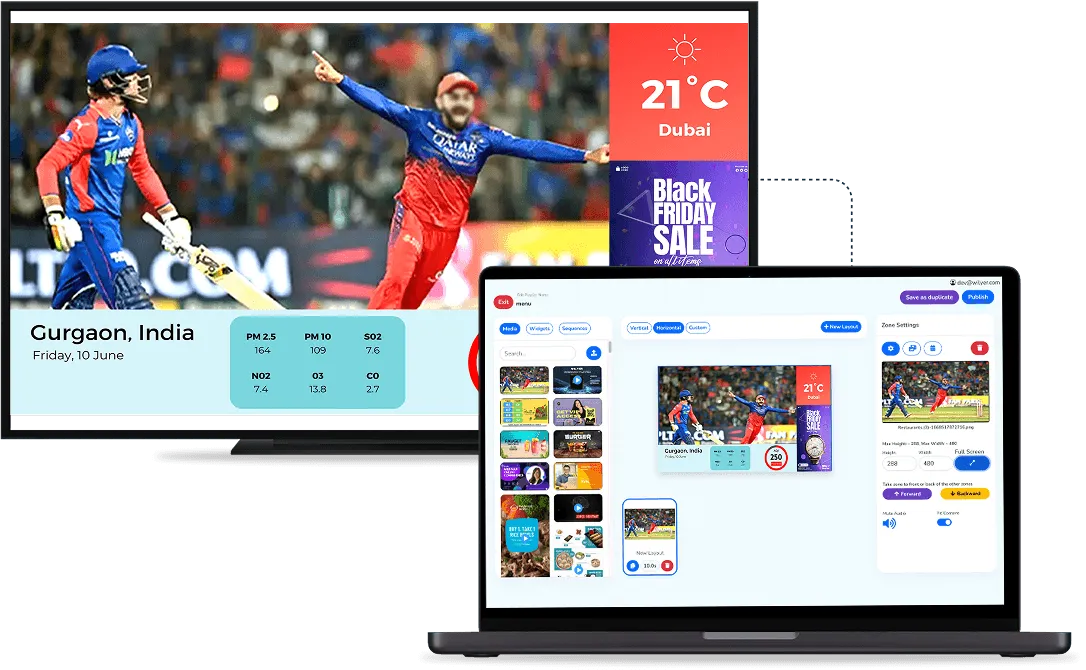

At a simple level, digital signage software connects your content to your screens, and manages what plays, when, and where. Here’s a clear, step-by-step explanation based on your script.
Core architecture:
- Server / CMS (Cloud or On-Prem): the central brain where you upload content, build playlists, schedule times, manage devices, and view reports. It hosts storage, databases, and the business logic.
- Client app / Player: a small application running on each screen or media player (Android TV, Windows box, FireStick, Tizen/webOS native app, or a dedicated player). This app pulls content and instructions from the server.
- Network connection: screens connect via LAN or Wi-Fi to fetch updates; for cloud setups this is over the internet, for on-premise it can be within the local network.
Typical workflow:
- Pairing: you install the client app on the screen/player and pair it with the CMS (often via OTP or pairing code).
- Upload & schedule: on the CMS you upload content (images, videos, widgets), create playlists, and schedule when/where things play.
- Delivery: the server pushes or the player pulls content. Web sockets or polling handle real-time updates.
- Playback & caching: the player plays content. It caches content locally so the screen continues to play even if the network drops (offline playback).
- Monitoring & logs: the CMS receives heartbeats from devices, stores playback logs (proof of play), and lets you take screenshots or reboot devices remotely.
- Integrations: APIs and widgets pull live data (weather, news, dashboards, POS), or accept triggers (sensor data) to change content dynamically.
Deployment choices:
- Cloud CMS: easier to scale, manage remotely, and update.
- On-premise CMS: used when data must stay internal or for tricky network environments.
Key operational tips:
- Make sure the player auto-launches on boot and auto-reconnects after power loss.
- Test offline playback behavior.
- Use grouped playlists and time-based rules for flexible campaigns.
In short: the CMS is the command center, the client app is the player on each screen, and stable network + offline caching makes the whole system reliable in real environments.
Get a hands-on view of how playlists, scheduling, and monitoring work, try a demo of our digital signage software .