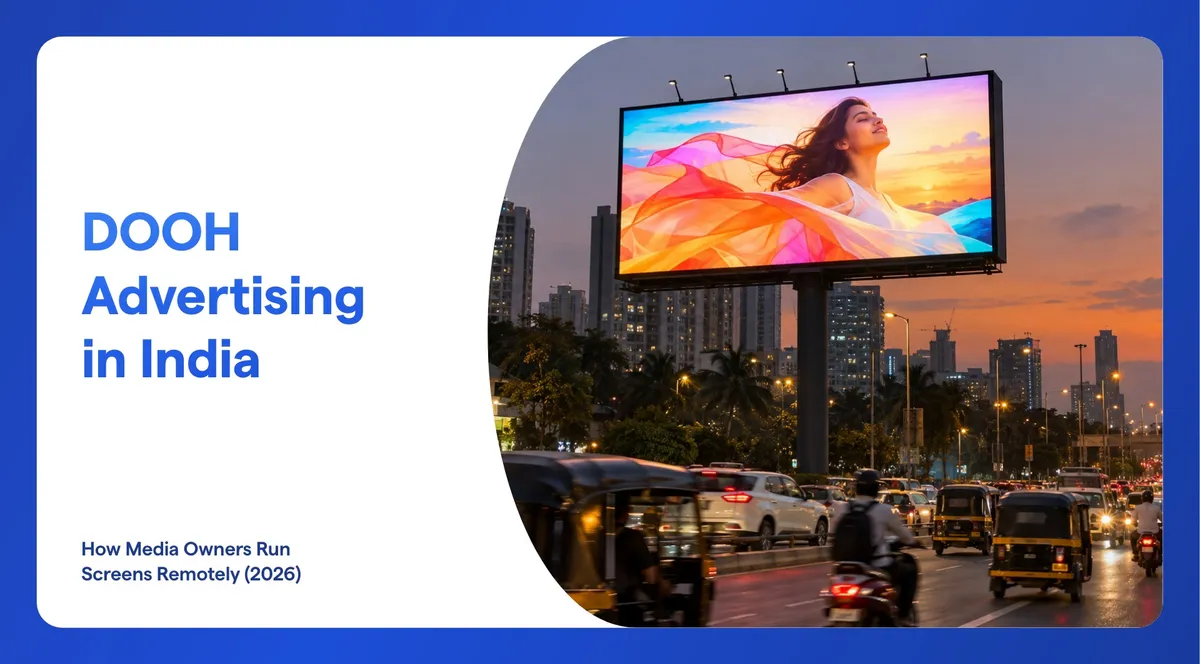
DOOH advertising (digital out-of-home) means ads shown on digital screens in public places: roadside LED billboards, airport and metro screens, railway station displays, mall screens and lift lobby TVs. This guide to DOOH advertising in India is written for media owners, the companies that own the screens and sell time on them. It covers the market, city permissions, how to plan a loop and sell slots, what a proof of play report should show, and how to watch a network you cannot visit every day.
How Big Is DOOH Advertising in India?
Estimates differ widely, because each tracker counts a different part of the market. The most quoted source, the FICCI-EY 2026 report, values organised OOH at ₹6,690 crore in 2025, up 13%, and says digital screens earned 18% of it, up from 7% in 2023. Other trackers put the whole market lower and the digital share much lower:
| Source | OOH ad spend | Digital share |
|---|---|---|
| FICCI-EY, March 2026 | ₹6,690 crore in 2025, up 13% (gross estimate) | 18%, about ₹1,220 crore |
| Pitch Madison Advertising Report, February 2026 | ₹4,835 crore in 2025, up 4% | Not given |
| Digital Advertising Report by dentsu-e4m, February 2026 | ₹4,724 crore in 2025, 4% of all ad spend | Not given |
| WPP Media, June 2026 | About $0.5 billion in 2026, up 8.6% | Less than 5% |
FICCI-EY also counts 223,450 digital screens in India in 2025, up 21%, with 75% of them in the metros. That count comes from Lemma Technologies and was not independently verified by EY.
Two facts matter more to a media owner than the size. Programmatic buying is still only 1 to 2% of DOOH spend (PwC, via Media4Growth), so most screens are sold directly. And India has no audited audience measure for DOOH: the IOAA's chairman said in April 2026 that adoption of its RoadStar system "has been slow" (Media4Growth). Advertisers therefore judge a network on what it can prove: that their ad played as agreed.
Do You Need Permission to Run a Digital Billboard in India?
Yes, and there is no single national permit. Permission comes from the city's municipal body, or from the transport operator's tender for airports, metros and railway stations, and the rules differ from city to city. These are the rules that change how you run a screen, from public documents as of November 2026. Check the current rules with the local body before you install.
| Where | Who gives permission | Rules that affect the screen |
|---|---|---|
| Mumbai | BMC, with a traffic police NOC | Switch off at 11 pm on an automatic timer. Brightness must adjust by light sensor, not by hand or by a time schedule. No digital screens on dead walls (BMC policy, November 2025). |
| Delhi | Municipal Commissioner, case by case | Each message stays at least 8 seconds. No flashing. Screens should not face roads wider than 100 feet. Dim or switch off after 11 pm (Delhi policy, 2017). |
| Bengaluru | City corporation, by public auction or tender | No moving video or flashing LED content, and off after 11 pm (bye-laws notified July 2025). Draft 2025 rules propose still images for at least 10 seconds and 10% of screen time for public messages (Storyboard18). |
| Railway stations | Zonal railway, by e-auction on IREPS | Digital screens are allowed under the Rail Display Network policy (Railway Minister, March 2026). A tender can share screen time with railway information, for example 50:50 at Rewari in 2026. |
Two patterns run through most cities. Roadside screens near traffic usually show still images with a minimum time on screen, and screens switch off around 11 pm. Video loops fit malls, airports, metros, stations and private premises better than roadside boards.
What Do You Need to Set Up a DOOH Screen Network?
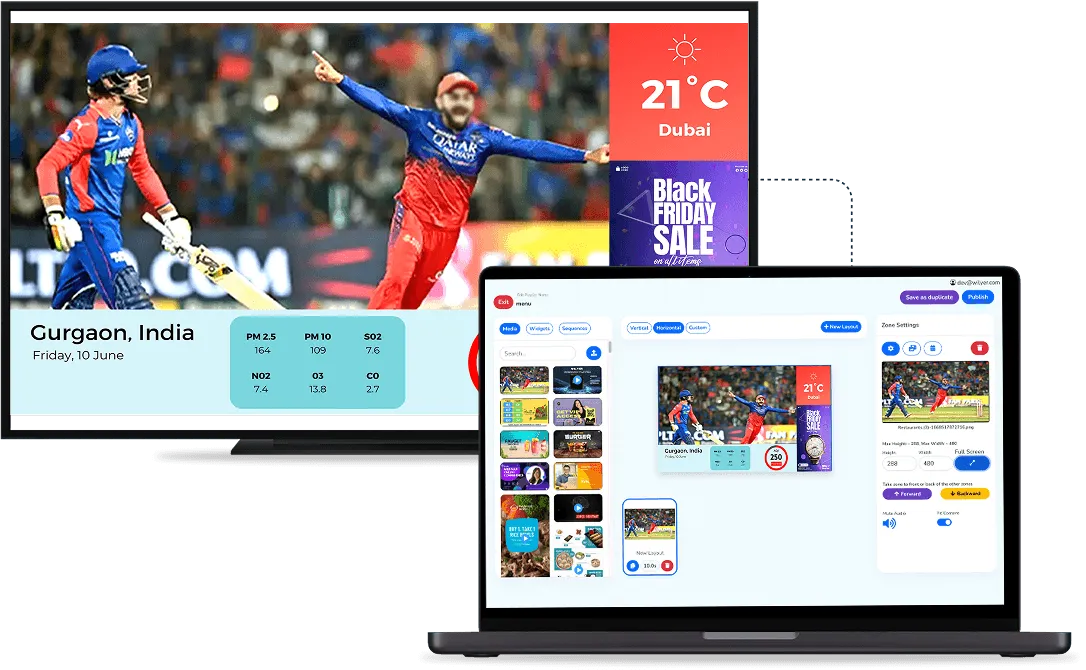
Three things: screens with a player, an internet connection, and digital signage software, also called a content management system (CMS), to run them. A network soon becomes a mix of LED billboards, commercial displays and TVs from different makers, so the software should run them all from one dashboard. With Wilyer, you install the app on the player or smart screen, pair it with a code, and manage every screen from one place, whatever its operating system. Our guide to LED screen costs in India covers the hardware side.
- Group screens the way you sell them: Wilyer supports groups inside groups, such as state, city, area and site, so you can publish a campaign to one city, one mall or the whole network.
- Approve every creative before it plays: role-based access and a maker-checker step mean an ad needs a second person's approval before it goes live. A wrong ad on a public billboard costs more than a short delay.
- Plan for power and internet cuts: the app keeps playing downloaded content when the connection drops, and picks up new content when it returns.
If you resell screens or software under your own brand, see white label digital signage software.
How Do You Schedule Ads by Slot in a DOOH Loop?
Most DOOH screens run a loop: a fixed rotation in which each advertiser owns a slot. There is no standard loop length. The Media Rating Council's example is a six-minute loop, and it notes that a loop is not required at all (MRC, December 2025). A simple worked example is a 60-second loop with six 10-second slots. Each ad plays once a minute, 60 times an hour and 960 times in a 16-hour day from 7 am to 11 pm, and each advertiser gets one sixth of the screen time.

| Loop | Slots to sell | Plays per ad per hour | Plays per ad, 7 am to 11 pm | Share of screen time |
|---|---|---|---|---|
| 60 seconds, six 10-second slots | 6 | 60 | 960 | About 17% |
| 120 seconds, twelve 10-second slots | 12 | 30 | 480 | About 8% |
| 60 seconds, half kept for station information | 3 | 60 | 960 | About 17% |
The last row is why site agreements matter: a 50:50 time share halves the slots you can sell, not the plays each advertiser gets. City rules change the maths too. With Delhi's 8-second minimum per message, a 60-second loop holds at most seven ads.
In Wilyer, you schedule playlists for chosen screen groups by date, time slot and day of the week: see our guide to playlists and how content scheduling works.
What Should a Proof of Play Report Show?
Proof of play is a report built from logs that show an ad actually played on a screen (IAB DOOH glossary). The MRC's 2025 standards add that buyer and seller should agree what the proof will contain before the campaign starts. A report an advertiser can trust shows:
- The ad: the advertiser, the creative file and the campaign dates.
- Where: each screen by name and location.
- How often: the number of plays per screen per day and the total play time.
- When: the first and last play time on each day.
- Visual proof: a screenshot of the screen while the ad is running.
Wilyer's playback reports show which ad played, on which screen, how many times and when, and you can export them as CSV or Excel to send to the advertiser. See how proof of play works for more.
Be clear with buyers about what a play log is. It proves the ad played, not who saw it, and it is the media owner's own record, not a third-party audit. If you quote impressions, call them estimates and explain how you counted them.
How Do You Monitor DOOH Screens Remotely?
- Live screenshots: see what a screen is showing right now, instead of sending someone to check a new campaign.
- Offline alerts: get an alert when a screen goes offline, and scheduled email reports that show which screens are online or offline.
- Power schedules: switch screens off and on at set times, to match the 11 pm switch-off in Mumbai, Delhi and Bengaluru.
- Brightness control: lower brightness by time of day, or let it follow the light around the screen when the screen has a light sensor. Mumbai's 2025 policy asks for sensor-based brightness, so check that your screens have a light sensor.
- Screen sync: make several screens show the same ad at the same moment, such as a row of screens along a concourse.
- Live streams: show a live RTSP feed on the screens next to the ads.
Our post on remote CMS for DOOH media owners covers the day-to-day benefits.
Case Studies: Mahakumbh and Ayodhya
Mahakumbh 2025, Prayagraj
Sri Garima Publicity put up 10 billboards, each 10 by 10 feet, in the crowds at Maha Kumbh 2025 in Prayagraj. The billboards showed ads, public announcements, event updates and live streams of the events, all run from the Wilyer cloud CMS. The network ran 24x7 through the event and delivered an estimated 400,000+ impressions for advertisers (read the Mahakumbh case study).
Ayodhya Railway Station
For the Ram Mandir opening on 22 January 2024, the same company ran 50+ screens at Ayodhya railway station. The screens mixed DOOH ads with RTSP live streams and live train status from a web page widget, and the team downloaded playback reports and shared them with advertisers as proof of play. In the words of Ashish, its founder: "The easy-to-use dashboard and detailed reports have made talking to clients and running things smoother" (read the Ayodhya case study).
Outside India, Alan Advertising & Media runs ads next to real estate partner content on 100+ retail screens in Saudi Arabia. In Bahrain, 7amdaan.io checks campaigns on 50+ guide robots in airports and malls with remote screenshots instead of site visits.
Frequently Asked Questions
What Is the Full Form of DOOH?
DOOH stands for digital out-of-home. It means advertising on digital screens outside the home, such as LED billboards, airport and metro screens, railway station displays, mall screens and lift lobby TVs. Unlike a printed hoarding, one DOOH screen shows several ads in rotation, and they can be changed remotely.
How Big Is the DOOH Market in India?
FICCI-EY estimates that digital screens earned 18% of India's organised OOH revenue of ₹6,690 crore in 2025, about ₹1,220 crore, and expects 25% by 2028. Other trackers are more cautious: WPP Media puts DOOH at less than 5% of OOH.
What Is a Proof of Play Report?
A proof of play report is a log that shows an ad actually played: which file ran, on which screen, how many times and when. Media owners send it to advertisers as evidence that a campaign ran as agreed. It proves playback, not who saw the ad.
How Long Should a DOOH Ad Be?
There is no national standard. This guide uses 10 seconds per slot as a worked example. Some cities set a minimum for roadside screens: Delhi's 2017 policy asks for at least 8 seconds per message, and Bengaluru's draft rules propose at least 10 seconds.
Is Programmatic DOOH Common in India?
Not yet. Programmatic buying is about 1 to 2% of Indian DOOH spend, and most screens are still sold directly. Wilyer supports VAST ads. If you plan to sell programmatically later, talk to our team about your setup.
How Much Does DOOH Software Cost?
Wilyer Pro costs ₹1,200 per screen a month, or ₹12,000 a year, plus GST. The free trial gives you 15 screens for 14 days with all Pro features and no card.
Getting Started
Start with one site, a written loop plan and a sample proof of play report you can show buyers, then add screens city by city as you sign advertisers. See how Wilyer works as DOOH advertising software, start a free trial with 15 screens for 14 days, or book a demo.